Bochum Bunkum
Short and sweet for his one, but it does allow the addressing of many claims made about transmissions from the moon and how they were intercepted.
In this case, our faithful doggy is refuting claims made about a recording made by Bochum observatory of Apollo 11 descending to the lunar surface. That recording can be found here.
I haven’t seen the original claim to which he’s responding, but I’ve seen his response, as well as an earlier one relating to tracking.
The claim he’s disputing is that NASA sent tapes of Apollo recordings to be digitised, and he’s also stating that Bochum had no formal involvement in Apollo 11.
He’s absolutely correct: Bochum observatory did not form any part of any of NASA’s tracking or communications network -

Germany is conspicuous by its absence, so there’s no reason whatsoever that NASA would ask them for anything, or to do anything.
Then it all seems to get a bit confused for stray as he copies and pastes his pet AI’s responses. He seems happy that Bochum was able to receive S-
Bochum could detect the S-
Bochum could not extract or hear any astronaut voice or telemetry.
Bochum’s 20-
What about the voice recordings made by Bochum then?
Now, I’m not sufficient an expert in Unified S-
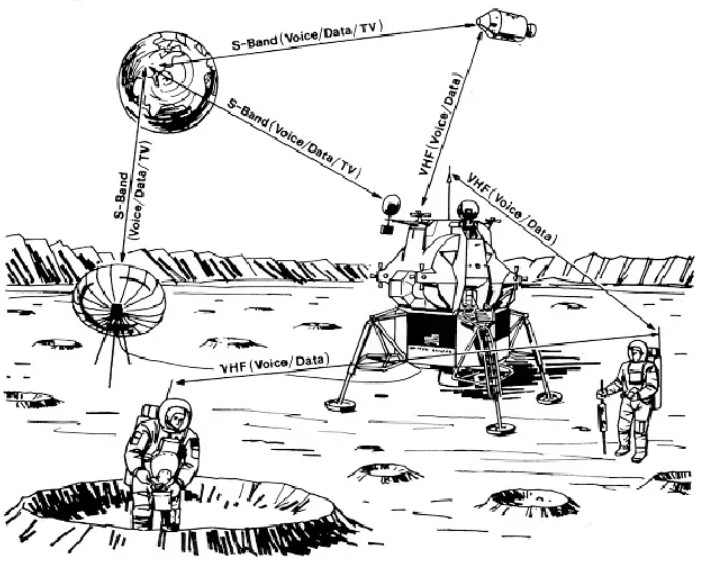
While data, telemetry, TV and voice transmissions were all packed into USB transmissions, the lunar module and command module communicated with each other with VHF. The VHF signal wasn’t powerful, but there is absolutely nothing in the way of those transmissions other than a few miles of atmosphere. Radio hams send transmissions to the moon and back for fun as ‘moonbounce’ (or ‘EME’, Earth-
This diagram, from a 1969 ‘Electronics World’ shows the various communications links.
It’s those leaky transmissions that the receivers on Earth, be they amateur radio hams like Larry Baysinger, or professional astronomers like Bochum observatory, are picking up.
Baysinger’s recording was from the astronaut suit transmissions, but Bochum’s features the actual landing process itself, so has to come from the LM during flight. How come?
This site has the explanation.
The S-
In simplest terms, the larger the amount of information being sent, the bigger the dish you need to intercept and decode the S-
So the reality is that while you need a big dish to intercept and decode S-
Stray makes many more errors in his interpretation of reality. He says this:
Most of the "Bochum tapes" people hear today were actually recordings of the Voice Call (NASA's public broadcast) or signals relayed to them.
When the reality is, like Baysinger’s recordings, all you hear is the Apollo 11 conversation, not the corresponding voice from Houston. He’s also critical of a claim that Bochum recorded lunar rover TV footage from Apollo 16. There is, as far as I am aware, no recording available of that broadcast, but it is reported in many places -
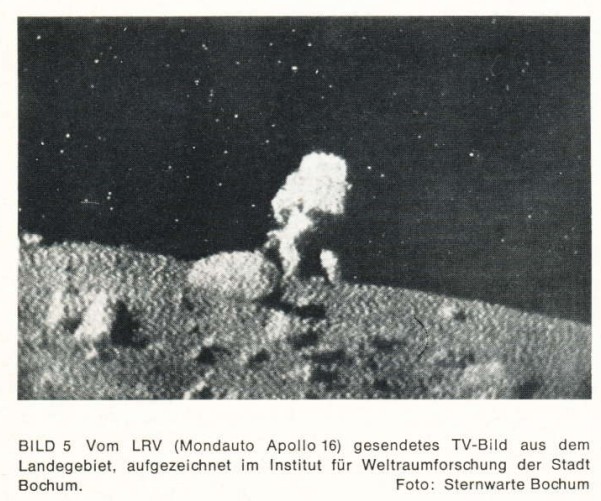
So despite his protestations that it was impossible, there we are. He doesn’t really say why it’s impossible, but trust me bro, AI says so. Stray does emphasise that they couldn’t have decoded colour TV, but there’s no claim (as far as I can tell) that colour was decoded, just a TV signal.
His notions about dish size are worth examining. He’s confident that Bochum’s 20m dish couldn’t decode TV, but a 3m wide portable S-
The command module’s S-
This document describes dishes as small as 30 feet (just over 9 metres) at 11 stations in the tracking and communications network, 3 stations with 85 feet dishes (25 metres), and the largest 210 feet (64 metre) dishes at Goldstone and Parkes.
It describes how:
“The 85-
It also says:
“A 210-
The document also discusses ‘herringbone’ interference, noticeable on the ground, caused by the presence of other information in the signal (such as telemetry) that better decoding equipment can remove, but obviously hasn’t been here.
So while bigger dishes are preferable, smaller dishes would do an adequate job of sending TV, and would obviously be more than capable of receiving voice alone.
Similar arguments are made relating to Soviet interception of S-
This document discusses the equipment aimed specifically at intercepting signals from Apollo. This one, when translated, says:
“Under [M.S. Ryazansky's] leadership, a ground control complex was created to control Soviet manned and unmanned spacecraft for lunar exploration, which included two flight control centers, six ground and three ship control posts equipped with appropriate tracking stations, and located both on the territory of the Soviet Union and at certain points in the World Ocean. However, these facilities could not be used to receive information from the Apollo ships, since they operated in a different frequency range with signals that had a different structure. Therefore, at the suggestion of M.S. Ryazansky, it was decided to create a special control complex capable of receiving data from the Apollo ships. It was supposed to receive not only telephone (voice) and telemetry information from the American spaceships, but also television information.
It was decided to include in the control complex the TNA-
It was later used as a receiving antenna for the Saturn-
To operate as part of the control complex, the TNA-
The control complex, created in a short time by the enterprise in cooperation with several industrial enterprises, was ready to receive signals from the Apollo spacecraft in November 1968.
In order to track American lunar ships during their flight in orbits around the Moon and during landing on its surface, it was necessary to have ballistic data of these orbits to calculate target designations for the antenna. However, such information was not published by the Americans. Therefore, data on flight orbits were calculated by ballisticians based on the time of launch and arrival to the Moon of the Apollo ships, which were reported by American radio. Based on this data, targeting instructions were calculated for pointing the antenna, which were refined based on signals received by the control complex from the lunar ships.
This approach to calculating target designations made it possible to receive signals from the Apollos quite reliably. The task of searching for signals was made easier by the fact that the antenna pattern covered almost half of the Moon's disk.
The Apollo 8, 10, 11, and 12 spacecraft were tracked from December 1968 to November 1969.
All these ships received good quality telephone conversations between astronauts and Earth and telemetry information about the state of onboard systems. The received television signal was of low quality due to the insufficient energy potential of the radio link based on the 32-
And they even produce a (poor quality, admittedly) view of Earth broadcast from the moon.
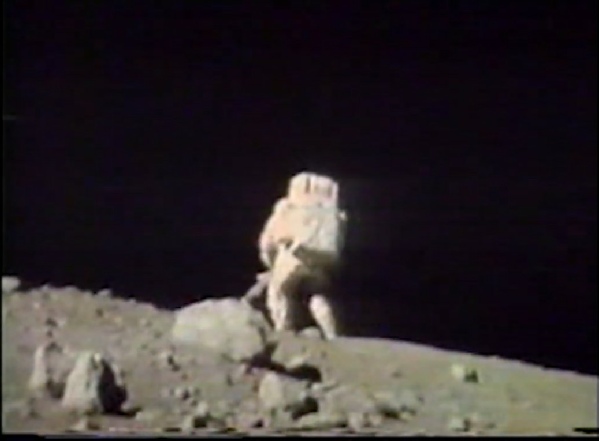
The still is from EVA-
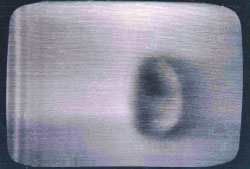
Their own spacecraft also used S-
In addition to Bochum and Baysinger, Italian and Dutch amateurs and observatories also intercepted signals from equipment and people on the moon -
All stray and his fellow deniers have is, well, denial. Insisting (or rather getting AI to insist on your behalf) that something wasn’t done, or couldn’t be done without any actual evidence that this is the case proves nothing.
In a nutshell: you don’t need an massive dish to get S-
Amonst those amateurs are those documented in this June 1972 issue of QST magazine, who not only heard voice communications from Apollo 15 but used S-
“window screening, fishing string, and 1/2-
So if they can do it with a relatively low budget 4m dish, Bochum could certainly manage it with their set-